



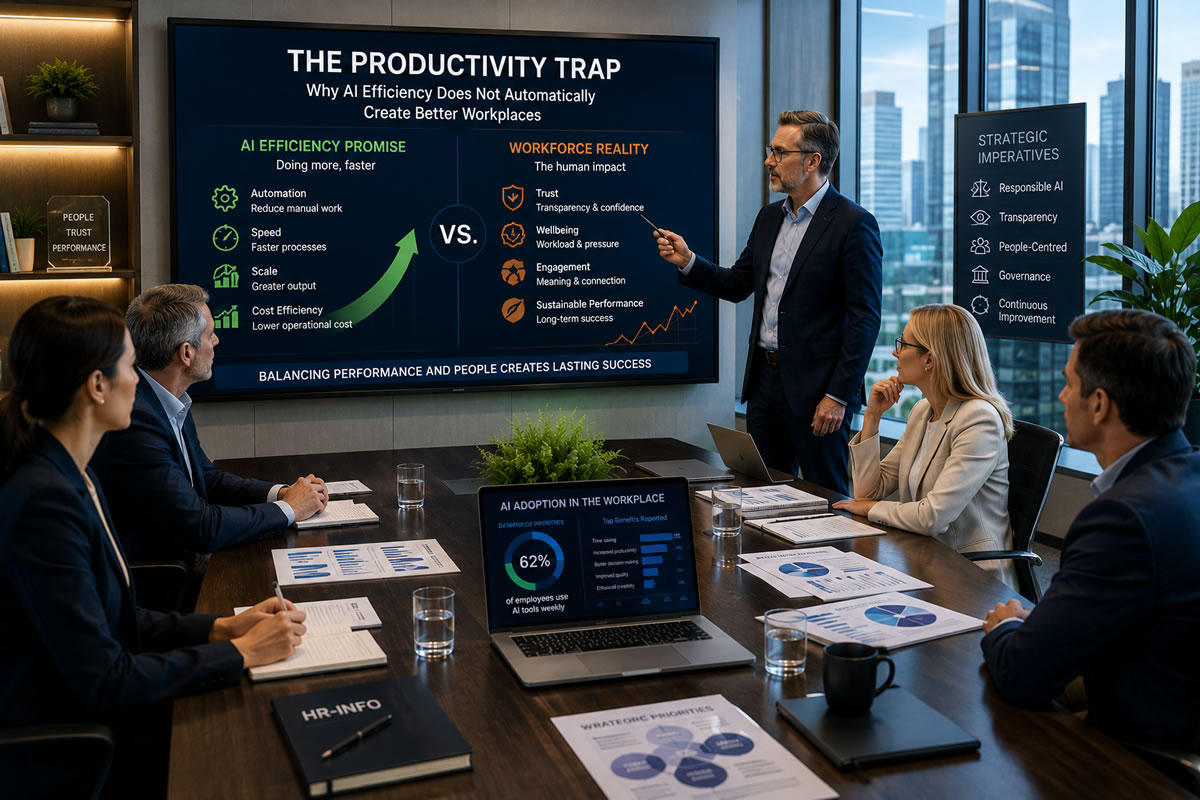
Artificial intelligence is increasingly being introduced into workplaces with the expectation that greater efficiency will naturally lead to stronger organisational outcomes. Businesses continue investing heavily in AI-powered systems designed to automate repetitive work, accelerate decision-making processes, and improve productivity across multiple functions.
On the surface, the assumption appears logical.
If tasks can be completed faster, organisations should theoretically become more productive. Yet emerging evidence suggests the relationship between AI and workplace performance may be considerably more complex than many organisations initially anticipated.
Recent workplace findings indicate that although AI users often report productivity gains, many simultaneously question whether those gains are translating into improved work experiences or stronger outcomes. Australian workers increasingly use AI tools in their day-to-day roles, yet some frequent users report uncertainty regarding their own effectiveness and productivity.
This introduces an important challenge for HR leaders.
Workplace productivity has historically been measured through relatively straightforward indicators including output, efficiency, and operational performance. However, modern workplaces increasingly require broader consideration of workforce trust, psychological safety, employee wellbeing, leadership capability, and long-term organisational sustainability.
Research into workplace AI systems is also beginning to reveal another emerging issue: many AI-related workplace incidents appear linked to misalignment between how technology is designed and what workers actually need. Some findings suggest developers frequently prioritise efficiency and speed while employees place greater value on precision, context, transparency, and practical support.
This distinction is important.
Organisations focusing exclusively on efficiency improvements may unintentionally create environments where employees feel increased pressure despite technological assistance. Faster systems do not necessarily create better workplaces if implementation undermines confidence, trust, or employee experience.
Final Thought
Artificial intelligence will continue reshaping workplace processes and organisational structures over the coming years. However, productivity itself should not become the sole measure of success.
Organisations that achieve sustainable outcomes are unlikely to be those implementing AI at the greatest speed. More likely, they will be organisations capable of balancing efficiency objectives with broader workforce considerations including trust, transparency, and human capability.
Technology may improve performance.
People determine whether performance lasts.
HR-INFO Resources
As AI adoption accelerates, organisations should review governance frameworks, workforce policies, leadership capability, and workplace technology strategies to ensure innovation aligns with both operational and workforce objectives.
Explore professional workplace resources at HR-INFO.