


Adapted and expanded from the original article by David A. Bratton.
For decades, organisations have focused heavily on downward feedback — managers evaluating employees, identifying weaknesses, measuring productivity, and monitoring performance. But one of the biggest blind spots in leadership is often ignored:
Who evaluates the manager?
It is a question many workplaces still struggle to answer honestly.
The reality is that poor leadership habits frequently create the very performance issues organisations later criticise employees for. Delays, disengagement, poor morale, lack of accountability, and missed deadlines are not always caused by incapable staff. In many cases, they are symptoms of broken communication and ineffective management practices.
The Problem Most Employees Never Say Out Loud
Consider a capable employee who consistently falls behind schedule. On paper, it appears to be a time-management issue. But behind the scenes, the employee may be dealing with constant interruptions, shifting priorities, unnecessary meetings, or managers who repeatedly pull resources away from critical tasks.
Most employees will never openly challenge this behaviour.
Not because they do not recognise the problem — but because they understand the risk involved in criticising someone above them in the hierarchy.
This creates a dangerous organisational dynamic:
- Employees stop speaking honestly
- Managers stop receiving accurate feedback
- Leadership blind spots grow larger over time
- Performance issues become systemic rather than individual
The result is often frustration, disengagement, and eventually staff turnover.
Why Upward Feedback Matters
Forward-thinking organisations have long understood that leadership effectiveness cannot be measured solely from the top down.
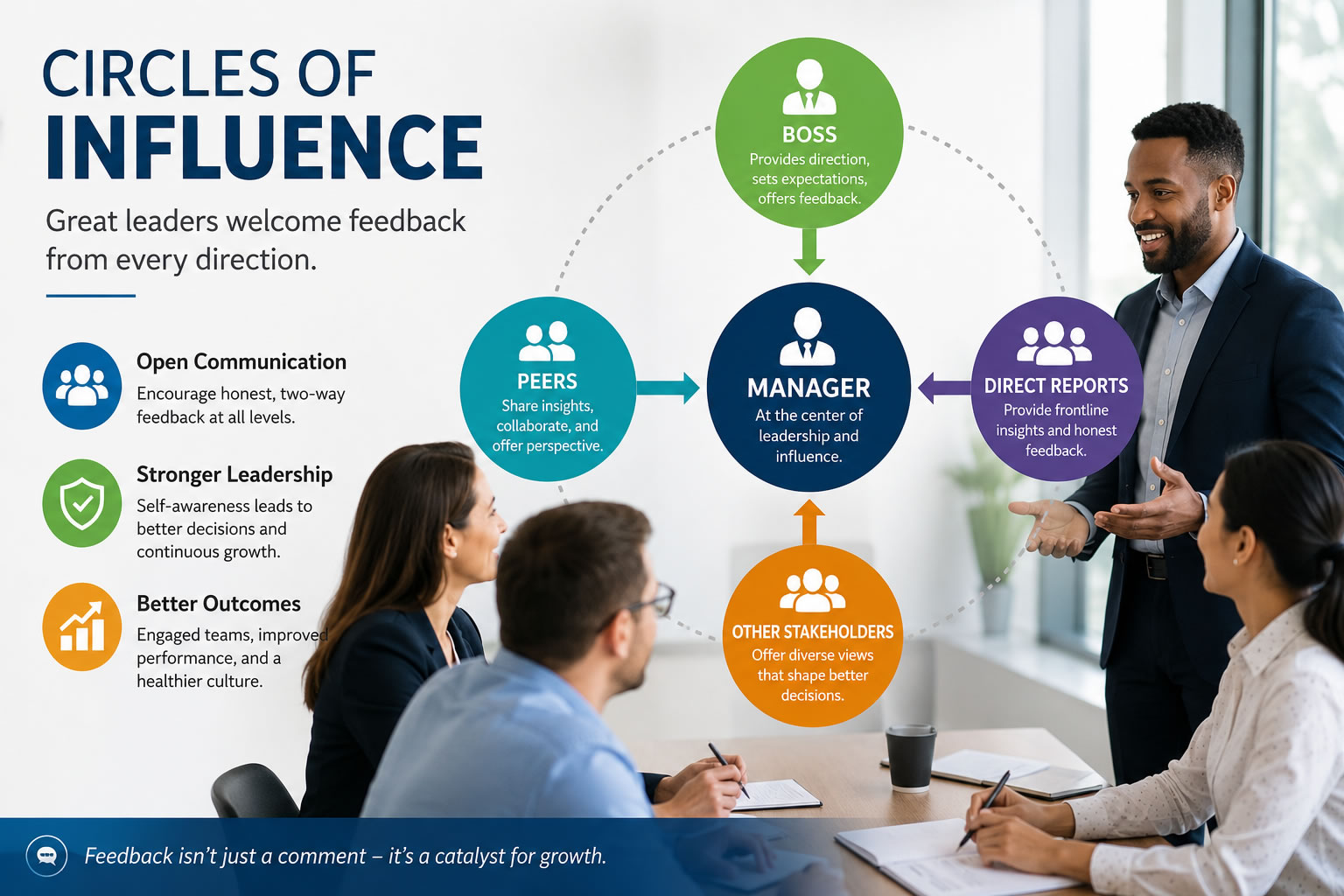
Some organisations introduced multi-source leadership feedback programs where managers receive input not only from senior executives, but also from peers and direct reports.
The purpose is not to embarrass managers.
It is to create self-awareness.
Many leaders genuinely believe they are approachable, supportive, innovative, or effective communicators — until structured feedback reveals a very different employee experience.
This gap between intention and perception is one of the most important leadership risks modern organisations face.
The Rise of 360-Degree Feedback
Today, what was once considered controversial has become standard practice in many progressive organisations.
360-degree feedback systems are now widely used to evaluate leadership capability across areas such as:
- Communication
- Coaching and mentoring
- Decision-making
- Accountability
- Emotional intelligence
- Team collaboration
- Change leadership
- Performance management
When implemented correctly, these systems can dramatically improve leadership capability and workplace culture.
But implementation matters.
Poorly designed feedback systems can easily become political, punitive, or performative.
Why Most Feedback Programs Fail
Many organisations launch leadership feedback initiatives with good intentions but fail to create the psychological safety needed for honest participation.
Employees quickly learn whether feedback is truly welcomed — or quietly punished.
If staff fear retaliation, anonymity is weak, or managers become defensive, the process collapses into meaningless “safe” responses filled with generic praise.
Successful programs usually share several characteristics:
1. Genuine Anonymity
Employees must feel protected when providing feedback upward. Without trust, honesty disappears immediately.
2. Leadership Buy-In
Senior leadership must actively model openness to feedback rather than treating it as a compliance exercise.
3. Development Focus
Feedback should primarily support leadership growth — not become a weapon tied directly to punishment or promotion decisions.
4. Ongoing Communication
Feedback should not occur once a year and then disappear. Effective organisations create continuous dialogue between leaders and teams.
Leadership in the AI Workplace Era
The need for upward feedback is becoming even more important as workplaces adopt AI-driven systems and automation.
Managers are now making decisions about:
- AI monitoring tools
- Productivity tracking systems
- Hiring automation
- Employee analytics
- Remote work surveillance
- AI-assisted performance reviews
Without open feedback channels, organisations risk implementing systems that damage trust, morale, and workplace culture.
HR leaders increasingly play a critical role in ensuring employees have safe ways to raise concerns about how technology impacts their work experience.
In many ways, modern leadership is no longer just about managing people.
It is about managing influence, transparency, and trust.
The Organisations That Will Win Long-Term
The strongest organisations are rarely the ones with the most rigid hierarchy.
They are usually the ones where communication flows in every direction.
Where employees feel safe speaking honestly.
Where managers remain curious enough to question their own leadership style.
And where feedback is treated not as criticism — but as operational intelligence.
Because leaders who stop listening eventually lose visibility of what is really happening inside their organisation.
Final Thought
One of the most revealing insights from early leadership feedback programs was simple:
Managers often improved not because they were forced to — but because they finally became aware of how their behaviour affected others.
That remains true today.
The best leaders are not the ones who avoid criticism.
They are the ones willing to hear it.
HR-INFO Resources
If your organisation is reviewing leadership capability, performance management frameworks, workplace communication policies, or AI governance practices, explore the professional HR compliance and management resources available at HR-INFO.
Original Author Acknowledgement
This article is based on concepts originally developed by David Bratton. He is an independent practitioner in the fields of human resource and change management consulting. His clients include financial services, high tech and aerospace manufacturers, airline and transportation companies. David has worked with clients in Canada, the United States and the United Kingdom. David can be found at his Web site, http://www.brattonconsulting.com/ (external link) or can be contacted by email at the following address: dbratton©brattonconsulting.com