



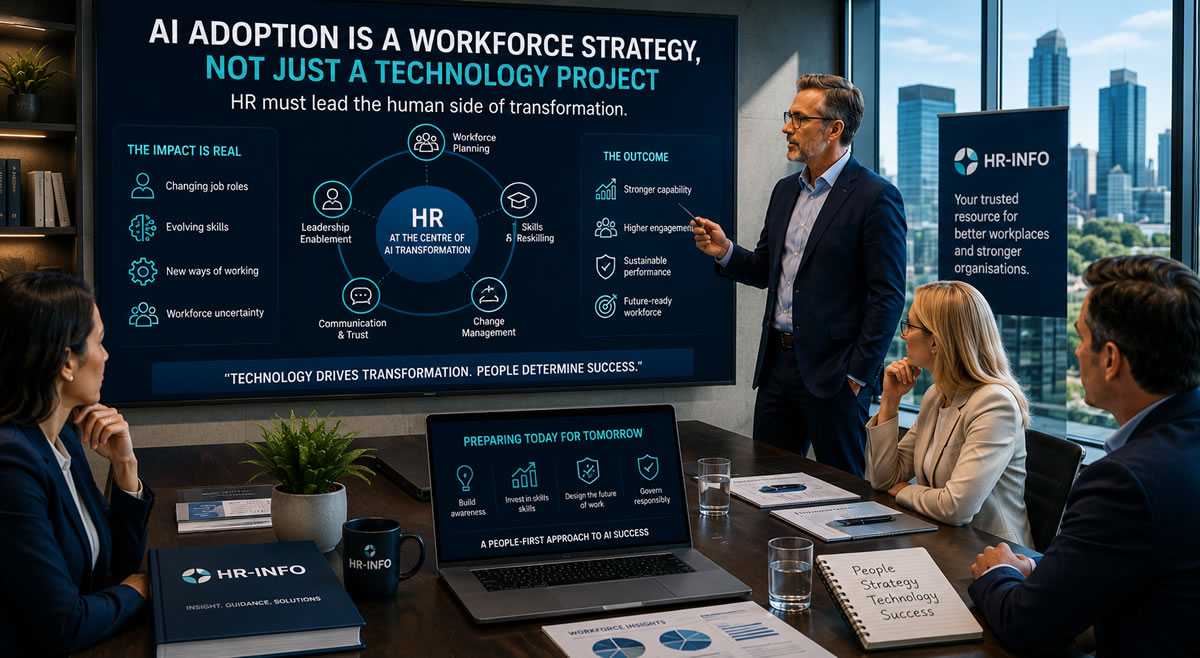
Artificial intelligence is rapidly moving beyond the experimental phase within many organisations. Increasingly, AI is influencing operational processes, workforce structures, hiring strategies, skills requirements, and long-term business planning.
As this transition accelerates, many organisations continue focusing heavily on technology deployment and productivity outcomes. However, an equally important challenge is emerging beneath the surface: workforce transformation.
The widespread adoption of AI is not simply a technology project. It is fundamentally a workforce change initiative.
Recent employment forecasts suggest that many occupations are likely to experience varying degrees of AI-related disruption over the coming years. While some roles may benefit from enhanced productivity and new opportunities, others may encounter slower growth, changing skill requirements, or significant role redesign.
This creates an important strategic responsibility for HR leaders.
Historically, technology implementation was often viewed primarily as an operational or IT function. Today, however, AI adoption increasingly intersects with workforce capability, employee trust, organisational culture, leadership effectiveness, and long-term talent strategy.
Evidence continues to emerge that employees are often more ready to engage with AI than organisational leaders assume, yet many organisations still lack coherent frameworks governing how AI should be introduced, communicated, and managed.
Without careful planning, organisations risk creating uncertainty, disengagement, and resistance even where AI initiatives are technically successful.
The challenge becomes particularly complex when AI adoption intersects with workforce planning decisions. Organisations face growing pressure to improve productivity while simultaneously maintaining trust, preserving capability, and supporting employee development.
As a result, HR leaders are increasingly required to operate at the centre of workforce transformation efforts.
This includes workforce reskilling, leadership education, communication strategies, organisational design, policy development, AI governance, and employee engagement. The objective is not simply to help employees adapt to technology, but to ensure technology adoption strengthens rather than weakens organisational capability.
Final Thought
Artificial intelligence will continue reshaping organisations throughout the coming decade. However, the success of AI initiatives is unlikely to be determined solely by technology performance.
More often, success will depend on how effectively organisations manage the human consequences of change.
The organisations best positioned for long-term success may not be those adopting AI fastest. Rather, they may be those that successfully balance innovation, workforce capability, employee trust, and organisational resilience.
Technology may drive transformation.
People determine whether transformation succeeds.
HR-INFO Resources
As organisations navigate workforce transformation, AI governance, leadership capability, workforce planning, and employee engagement become increasingly important strategic priorities.
Explore professional workplace resources, HR solutions, and practical guidance at HR-INFO.