



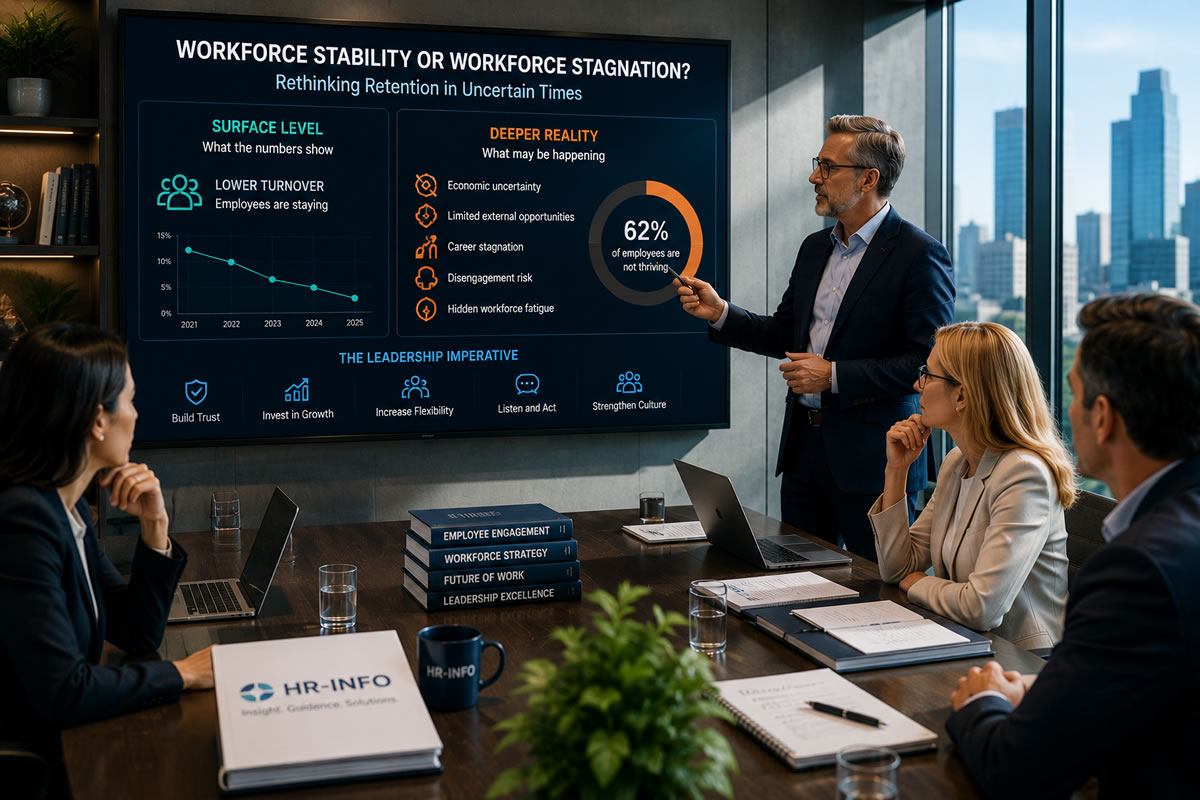
For many organisations, lower employee turnover is traditionally viewed as a positive indicator of organisational stability, workforce satisfaction, and effective leadership. During periods of economic uncertainty, businesses often interpret stable retention figures as evidence that employees remain committed and engaged despite broader market pressures.
However, the current workplace environment may require a more cautious interpretation.
Emerging workforce patterns suggest that employee retention alone may no longer provide an accurate measure of organisational health. In many sectors, employees appear increasingly reluctant to change roles, not necessarily because of stronger organisational loyalty, but because of growing economic uncertainty, slower recruitment activity, housing affordability pressures, and broader concerns surrounding financial stability.
This distinction is significant.
A workforce that remains in place due primarily to caution or insecurity presents very different organisational risks from a workforce that remains engaged because of genuine commitment and confidence in leadership.
For HR leaders, this introduces a more complex challenge surrounding workforce engagement and organisational sustainability.
Historically, retention strategies focused heavily on reducing employee departures. However, modern workforce conditions increasingly require organisations to examine the quality of retention rather than retention alone. Employees who remain within organisations while experiencing disengagement, limited career optimism, or reduced psychological connection to the workplace may contribute to lower innovation, weaker collaboration, declining morale, and reduced long-term organisational adaptability.
In this environment, low turnover can sometimes conceal underlying workforce fatigue rather than reflect organisational strength.
The issue is particularly relevant as many organisations simultaneously navigate economic pressure, productivity expectations, technological disruption, and changing workforce attitudes toward career progression. Employees increasingly prioritise security, flexibility, stability, and wellbeing while remaining cautious about external career movement.
This creates a workplace environment where disengagement may become less visible but potentially more entrenched.
The implications for leadership are substantial.
Organisations relying solely on retention statistics may fail to identify deeper workforce risks emerging beneath apparently stable employment conditions. Traditional engagement surveys may also become less reliable if employees moderate feedback out of concern for economic uncertainty or limited external opportunities.
As a result, HR leaders may need to reassess how organisational health is measured.
Greater emphasis may need to be placed on workforce sentiment, leadership trust, career development confidence, internal mobility, psychological safety, and long-term employee optimism rather than purely numerical retention outcomes.
Final Thought
Periods of workforce stability are not always periods of workforce strength.
Employees may remain within organisations for many different reasons, and not all of them reflect confidence, engagement, or organisational loyalty. In uncertain economic environments, retention figures alone can create a false sense of security if deeper workforce sentiment is left unexamined.
The organisations most likely to remain resilient over the long term may be those capable of understanding not only whether employees stay, but why they stay.
Because sustainable workforce stability depends not simply on retaining employees.
It depends on retaining trust, confidence, and engagement as well.
HR-INFO Resources
As workforce conditions continue evolving, organisations should regularly review leadership capability, engagement strategies, workplace flexibility frameworks, and long-term workforce planning approaches to ensure retention outcomes reflect genuine organisational strength rather than economic caution.
Explore professional workplace resources at HR-INFO.