


Inspired by original ideas from Ron Kaufman
Economic pressure changes customer behaviour.
When conditions tighten, organisations often look inward—cutting costs, streamlining operations, and in many cases, reducing investment in customer service. On the surface, this may appear logical. In reality, it is often the exact opposite of what is required.
Because in difficult times, service does not become less important. It becomes critical.
The Shift in Customer Expectations
When customers are more cautious with their spending, every purchase carries greater weight.
Decisions are slower. Expectations are higher. Tolerance for poor experiences is significantly lower.
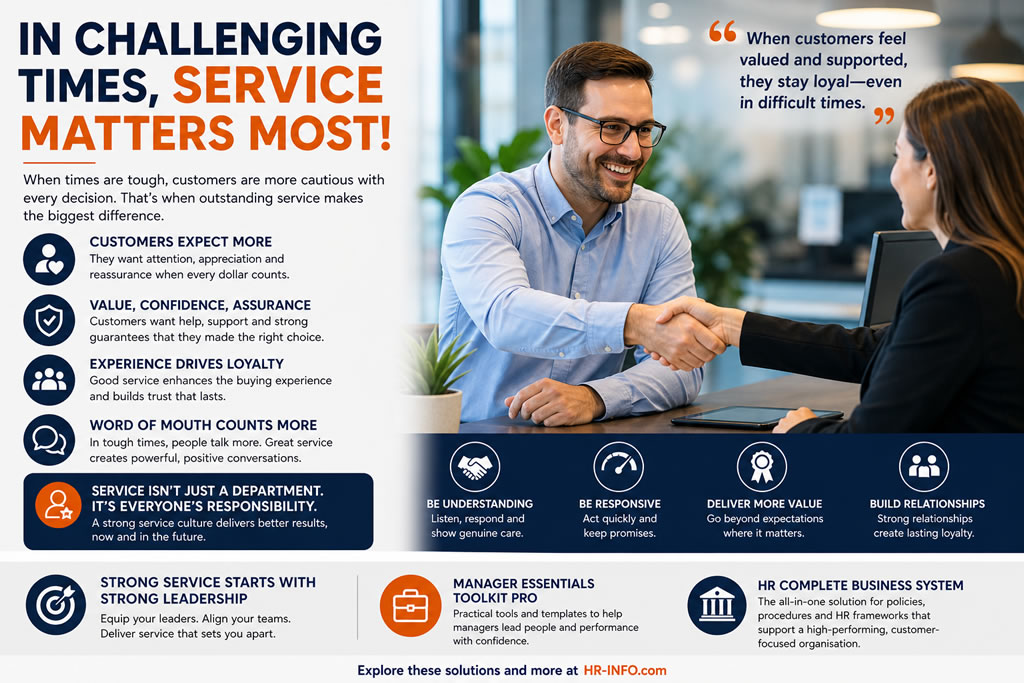
Customers are no longer simply buying a product or service—they are evaluating value, reassurance, and trust. They expect more support, clearer communication, and stronger confidence that their decision is the right one.
In this environment, service becomes the differentiator.
Why Service Defines Business Performance
Strong customer service does more than maintain satisfaction—it directly influences behaviour.
Customers who feel valued are more likely to return. They are more likely to recommend. And importantly, they are more likely to remain loyal even when alternatives exist.
In contrast, poor service during challenging times has an amplified impact. Negative experiences are remembered longer, shared more widely, and acted upon more decisively.
This makes service not just an operational function—but a strategic one.
The Reality Most Organisations Miss
In stable or growing markets, service improvements may go unnoticed. Customers move quickly, and expectations are more forgiving.
During uncertain periods, however, everything slows down.
Customers pay closer attention. They compare more. They notice details that would otherwise be overlooked. Every interaction contributes to how they perceive your organisation.
This creates a unique opportunity.
Organisations that elevate their service during difficult times stand out disproportionately. They build trust faster, strengthen relationships, and position themselves ahead of competitors who choose to scale back.
What Effective Service Looks Like
Delivering strong service in challenging conditions is not about dramatic changes—it is about consistency and intent.
It means understanding how expectations are evolving and responding accordingly. It means going beyond standard interactions to provide clarity, responsiveness, and genuine support.
It also requires managing expectations realistically.
Not every request can be fulfilled exactly as desired. However, organisations that communicate clearly, deliver reliably, and occasionally exceed expectations build credibility over time. Trust is established not by perfection, but by consistency.
Equally important is how organisations respond when things go wrong.
Service recovery is often more powerful than the original experience. When issues are addressed quickly, with accountability and a genuine effort to resolve them, customers remember the response—not just the problem.
The Internal Factor: Responsibility and Culture
Service quality is not created by systems alone. It is shaped by people.
In many organisations, service breakdowns are accompanied by blame—between teams, departments, or individuals. This does not solve problems. It reinforces them.
High-performing organisations take a different approach. They focus on ownership.
When individuals take responsibility for outcomes, suggest improvements, and actively contribute to solutions, service levels rise naturally. This mindset cannot be enforced—it must be embedded.
It is also supported by perspective.
Understanding the customer experience—seeing processes from their point of view—often reveals gaps that internal systems overlook. Organisations that regularly challenge themselves in this way are better positioned to improve.
Why This Matters More Now
Service is not a “nice to have” in difficult times—it is a stabiliser.
It supports revenue by retaining customers. It strengthens brand perception when confidence is low. And it creates differentiation when competitors are pulling back.
Perhaps most importantly, it builds long-term value.
Customers who feel supported during challenging periods are far more likely to remain loyal when conditions improve.
Where This Connects to HR and the Workplace
Service quality does not exist in isolation—it is driven by workplace culture, leadership, and clear expectations.
For organisations looking to strengthen service outcomes, the starting point is internal.
Clear behavioural standards, accountability frameworks, and consistent communication are essential. Without them, service becomes inconsistent—dependent on individuals rather than embedded in the organisation.
This is where structured HR frameworks play a critical role.
The HR-INFO Manager Essentials Toolkit PRO supports leaders in setting expectations, managing performance, and building accountability across teams—key drivers of consistent service delivery.
For broader alignment, the HR Complete Business System ensures that service standards are supported by clear policies, structured processes, and a cohesive organisational approach.
Final Thought
Challenging times expose weaknesses—but they also highlight strengths.
Organisations that reduce service to cut costs may survive in the short term. Those that invest in service build resilience, loyalty, and long-term advantage.
Service is not just how business is delivered.
In many ways, it is the business itself.
Original Author Acknowledgement
This article is based on concepts originally developed by Ron Kaufman, a recognised authority on customer service, leadership, and organisational performance. For more information and more insightful articles we strongly recommend that you visit his web site: http://www.ronkaufman.com/ (external link)