
Artificial Intelligence is no longer an emerging trend—it is already influencing how organisations hire, assess, manage, and plan their workforce.
Yet in many businesses, AI decisions are still being driven primarily by technology teams or external providers. The systems may be efficient. They may even be sophisticated. But without HR at the table, they are often incomplete.
Because AI in the workplace is not just about capability. It is about people.
The Missing Voice in AI Decisions
When AI is introduced into workforce processes, it reshapes how decisions are made—sometimes subtly, sometimes fundamentally.
Shortlisting candidates. Measuring performance. Identifying “high potential.”
These are no longer purely human judgements.
And that creates risk.
Not technical risk—but organisational risk. Bias that is embedded rather than visible. Decisions that are consistent, but not necessarily fair. Processes that are efficient, but not trusted.
These are issues that sit squarely within HR’s domain.
If HR is not involved early, these risks are not designed out—they are discovered later, often when the impact is already being felt.
From Support Function to Strategic Influence
This is where HR must reposition itself.
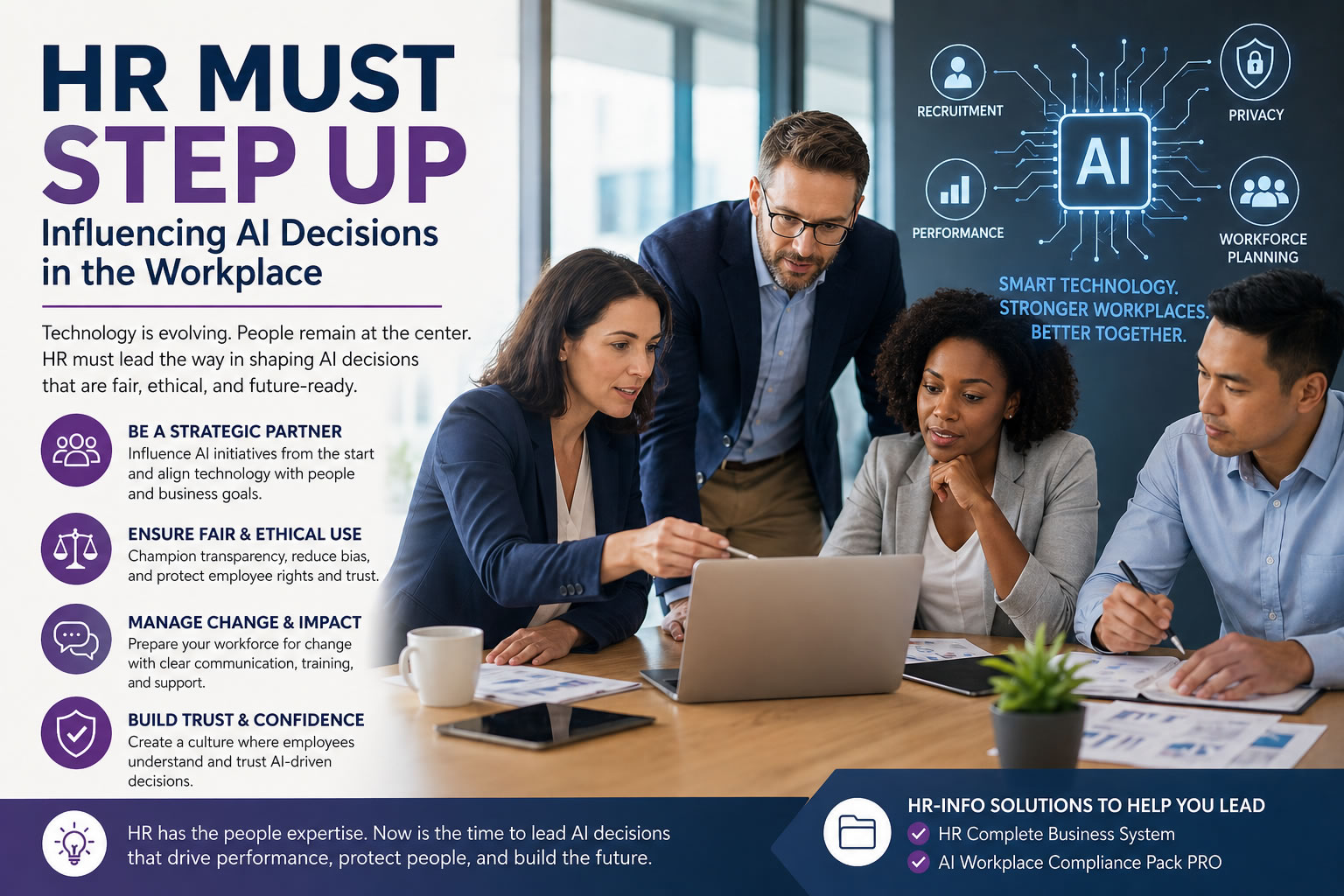
The traditional model—where HR supports implementation after decisions are made—is no longer sufficient. In an AI-driven environment, HR must influence decisions at the point where they are being shaped.
This does not require HR to become technical specialists. It requires something far more important: the ability to challenge, guide, and frame decisions through a people and risk lens.
Understanding how AI is being used, where decisions are being automated, and what that means in practice is now part of modern HR capability.
Without that understanding, influence is limited. With it, HR becomes essential.
Trust Will Define Success
AI introduces a level of opacity into the workplace that many employees are not comfortable with.
When decisions are not clearly understood, they are often questioned. When they are questioned, trust declines.
And once trust declines, performance and engagement follow.
This is why transparency is not optional.
Employees need to understand how AI is being used, what data is involved, and how decisions are reached. More importantly, they need confidence that those decisions are fair.
HR is the function best positioned to ensure that this balance is maintained.
The Broader Impact on the Workforce
AI will not just change how decisions are made—it will change how work itself is structured.
Roles will evolve. Some will expand. Others will disappear or be redefined. Skills that were once valuable may become less relevant, while new capabilities will be required.
Managing this transition is not a technical exercise. It is a workforce strategy.
Without clear planning, communication, and support, organisations risk creating uncertainty rather than progress. HR must lead this transition—not react to it after the fact.
Where This Becomes Practical
For many organisations, the challenge is not recognising the importance of HR’s role—it is operationalising it.
Influence requires structure.
Clear policies on AI use. Defined governance frameworks. Practical guidance for leaders making day-to-day decisions involving AI. Without these, even well-intentioned organisations rely on inconsistent judgement.
This is where structured HR frameworks become critical.
The HR-INFO AI Workplace Compliance Pack PRO provides a practical foundation for organisations introducing or expanding AI—covering governance, acceptable use, transparency, and risk management.
For businesses looking to embed these principles more broadly, the HR Complete Business System ensures that AI adoption sits within a consistent, well-governed HR environment rather than being treated as a standalone initiative.
Final Thought
AI will continue to move forward—quickly, and often without waiting for perfect conditions.
The organisations that succeed will not be those that simply adopt AI.
They will be those that apply it with control, clarity, and credibility.
HR has the expertise to provide that balance.
The only real question is whether it chooses to lead—or be left responding to decisions made without it.